Author Archive

Modular Music Box – Notes to Mike Cook 2

So sticking with the winder as a starting point I’ve collected together some of the components and internal fixings…

I supply..

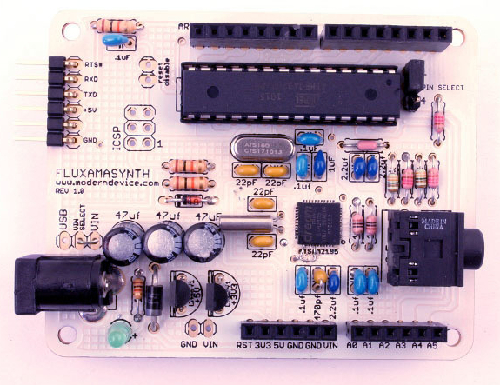
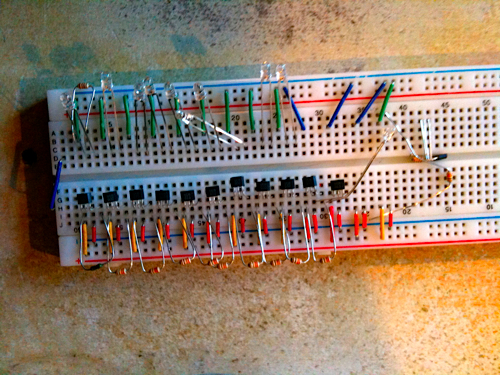
The acrylic top plate with 12 orange 3mm LEDs and a rotary encoder glued in and wired up (all but the encoder button are soldered) – the one quirk being that I got the blue and purple strands of the ribbon cable out of order… so with the panel face up and micro usb breakout board etching at the bottom the LED configuration is:

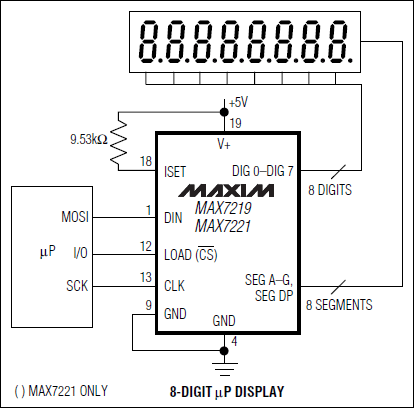
12 o’clock – white – anode – MAX7221 22 SegDP/white – common cathode – MAX7221 2 Dig0
1 o’clock – grey – anode – MAX7221 14 SegA/white – common cathode – MAX7221 2 Dig0
2 o’clock – blue – anode – MAX7221 16 SegB/white – common cathode – MAX7221 2 Dig0
3 o’clock – purple – anode – MAX7221 20 SegC/white – common cathode – MAX7221 2 Dig0
4 o’clock – green – anode – MAX7221 23 SegD/white – common cathode – MAX7221 2 Dig0
5 o’clock – yellow – anode – MAX7221 21 SegE/white – common cathode – MAX7221 2 Dig0
6 o’clock – orange – anode – MAX7221 15 SegF/white – common cathode – MAX7221 2 Dig0
7 o’clock – red – anode – MAX7221 17 SegG/white – common cathode – MAX7221 2 Dig0
8 o’clock – white extension – anode – MAX7221 22 SegDP/grey – common cathode – MAX7221 11 Dig1
9 o’clock – grey extension – anode – MAX7221 14 SegA/grey – common cathode – MAX7221 11 Dig1
10 o’clock – blue extension – anode – MAX7221 16 SegB/grey – common cathode – MAX7221 11 Dig1
11 o’clock – purple extension – anode – MAX7221 20 SegC/grey – common cathode – MAX7221 11 Dig1
(more…)

Modular Music Box – Notes to Mike Cook 1

Just to recap – there are 5 units

  • rotary sequencer – Arduino Mega 2010 + Adafruit Motor shield – I2C master
  • sound module – Fluxamasynth rev1.0 – I2C slave (this to check)
  • winder – Arduino Duemilanove – I2C slave
  • ballerina praxinoscope – via Adafruit Motor shield
  • battery

I’ll start with the ‘Winder’

Three main elements here for integration into a protoshield to sit on a DFRobot.com Arduino Duemilanove clone… :

  1. driving 12 orange 3mm LEDs – MV7744 – via a MAX7221 and the LedControl-library – or ideally a TLC5940 if you can get it to work with an I2C bus
  2. rotary encoder
  3. I2C

(more…)

Modular Music Box – Arduino polyphonic audio 2

While the Auduino project provides plenty of code tweaks and hardware hacks to make an easy to use but versatile monophonic synth the Modular Music Box requires polyphony…

So I’ve been on a mission to try and find a suitable solution…

(more…)

Modular Music Box – Hall Effect Sensors

I wanted to test the hall effect sensors I’d bought to see if they could be used for my idea of a rotary magnetic sequencer for the Modular Music Box.

There’s a link to the data sheet and a handy Hall_ Applications_Guide.PDF as well as some useful advice on the Sparkfun Hall Effect Sensor page and in the comments… and the Arduino:Playground provided a bit of code to test the sensor in action…

“You’ve got 3 pins from the front (the triangle edge). Left to right, power, ground, output.
Stick a 10k pull up between 5v and output. Then it’ll latch on/off depending on the poll you use.”

(more…)

Modular Music Box – MAX7221

The ‘Winder’ in the MMB has a ‘clock face’ of 12 orange LEDs in a circle used to give visual feedback on which way and how much to wind the key… as well as display the ‘winding down’ of the mechanism.

While I could have managed this by using an LED per digital output on the Arduino Duemilanove clone – I thought I’d use it as an opportunity to work with and learn more about LED drivers.

(more…)

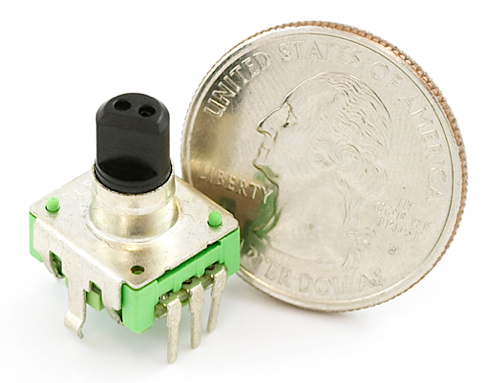
Modular Music Box – Quadrature Rotary Encoder

The Rotary Encoder page at SparkFun has a datasheet, tutorials and additional info and advice in the comments:

  • though medecau’s QuadEncoder Arduino library doesn’t compile…
  • tronixstuff’s Chapter 11 section on the rotary encoder – and the code works well enough – though there’s a fair amount of ‘bouncing’…
  • but with a little additional research I managed to get the Reading rotary encoder on Arduino example code to work – and it does seem to provide the most consistent and ultimately useful response to encoder input for my needs.

(more…)

Modular Music Box – Power Requirements

Although electronics is not really my strong point, I spent some time working through the spec sheets for all the various components in the Modular Music Box in an attempt to work out total power consumption – to give a better idea of the battery mAh rating we’d need and some idea of how long they’d last…

Things have changed since this early list and I’m sure I haven’t taken everything into account – the LVBoost now in the battery pack is probably only running at ~60% efficiency for a start – but here’s my initial working out for the record…
(more…)

PEAL – Bell Posts – Fabrication…

PEAL-design-options

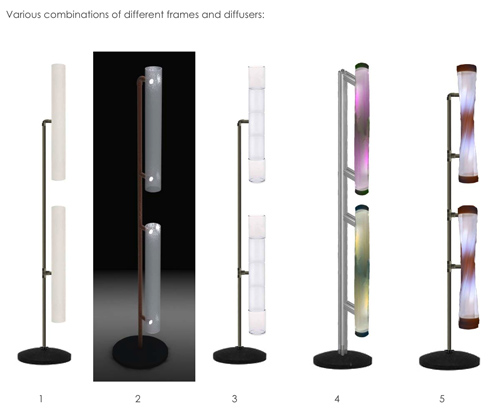
One particular area of concern has been the design and construction of the eight ‘bell posts’… and with budget tightening and schedule contracting we were keen to make sure this was one aspect of the project that didn’t get squeezed too far. The bell posts are the main physical manifestation of PEAL – the sculptural and physical elements of the piece that the audience interact with ‘up close and personal’ – and so we want to make sure they have the design aesthetic and quality of build we’re aiming for with the project overall.

Nick and I approached several designers and fabricators through out mutual networks and have now engaged with Duncan Fitzsimons – a graduate of the MA. Industrial Design Engineering, Royal College of Art and a member of Vitamins design – a multi-disciplinary design collaborative based in London.

(more…)

PEAL – Branding, Graphic Design & Visualisation

PEAL-logo-rough

Malcolm Garrett, RDI – Creative Director at Applied Information Group (AIG) has been developing the PEAL branding and graphic design for the ‘monitor’ output – and though still in development we think its circularity and clean, minimal vector aesthetic and historical font are right on tip. There are a series of variations for each of the installation modes: idle (above); self play, guided play, performance and timepiece.

(more…)

Monome meets 3D-AudioScape

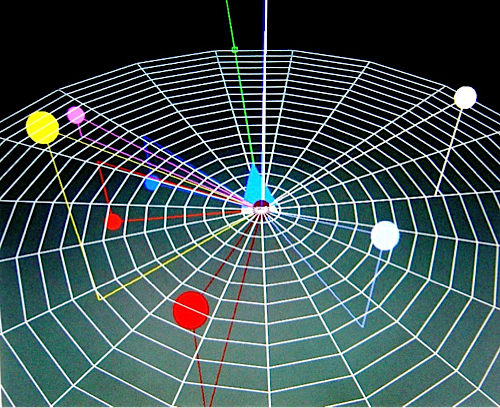
We’ve been developing the idea of using the monome to position and trigger up to 8 sounds within the Illustrious 3D-AudioScape facility… and Martyn Ware is up for it…

3D-AudioScape

The Illustrious Company’s 3D-AudioScape surround-sound system                      

Built by Paul Gillieron Acoustic Design and refined by Illustrious, the 3D-AudioScape surround-sound system comes closer than any other to the holy grail of ultra-realistic sound. It achieves this through two rings of speakers, one high and one at ground level to create a three-dimensional (X,Y and Z) virtual sound space. Illustrious’s unique visualisation/spatialization software positions up to sixteen separate sound channels within this virtual space which are then are able move in any direction, including up and down, in real-time. 

(more…)

Fresh out the box…

(This entry written for Martyn Ware… but could be useful to others…)

The monome.org site has lots of useful information, tutorials, apps and patches… but is, typically of open source communities (though better than most), messy and a bit difficult to find your way round if you’re new to it. The best place to start is the new monome docs and in particular the setup section…

m64 packaging

To get the monome up and running you’ll need the following essential (E) and recommended (R) drivers & software:

(more…)

monome ‘musings’

This post is partly a response to Ant’s most recent email to me:
“I’m feeling slightly up a blind alley with the Monome at the moment. It’s a wonderful piece of hardware, it’s beautiful, fast, flexible etc but utterly meaningless at the moment. I can’t think of an interesting way to use it.”

lewis-m64

I wanted to update my profile at monome.org with a photo and some info – now that I’m starting to post regularly. I was thinking about suitable 1 bit 8×8 pixel graphics – and thought of Space Invaders (obviously)… and tracked down (with surprising difficulty) a set of characters in this Invader from Space font. It turns out most of them aren’t actually 8×8 pixels 🙁 – but there are a few that are and I’ve chosen my favourite 😉

We haven’t had a chance to meet and really talk in the past few weeks – since getting the devices in fact – so I thought that a bit of critical reflection might help Ant understand my perspectives – and let me highlight some illustrative examples – and that might help him… possibly…

(more…)

Getting the Monome to sing…

monome011.jpg

The Monome is easy to communicate with and fast, and it’s really nice to have a computer interface that looks and feels right.

Made a 1 bit 8×8 webcam display out of it as a test. It’s quite fast too.

discome (I Feel Love)

As part of discome project I’m working on a version of Donna Summer’s 1977 disco classic I Feel Love…

Summer/Moroder

Here’s an interesting Wikipedia article on the track… which says that this is the first disco-style song recorded with an entirely synthesized backing track!

In attempting to de/reconstruct it in Ableton Live I’ve come to realise what a groundbreaking production Giorgio Moroder and Pete Bellotte actually created for its time. There is so much complexity and subtlety within what initially seems to be the fairly straightforward instrumentation and arrangement – which is why I suppose it’s such a classic and timeless track – der! So I’ve resolved to do my upmost to create a worthy monomatic version to reflect this… something I’ve just not found in those few remixes and reworkings I’ve actually listened to – of which there are very, very many…

Here’s the orginal… and my working rough…

[display_podcast]

(this is just a first draft instrumentation and arrangement and is far from finished… but it’s coming along well I think)

Next I’ll be attempting to create robotic renditions of the main and harmony vocal lines using Repeat After Me 1.3 – Apple’s phonetic Text To Speech app bundled in the OS X Leopard Developer Tools.

discome

discome is the meeting point between the minimalist interfaces of monome and the pixelised design of sensomatic’s discomatic.

The momome is a beautifully designed, hand-crafted, minimalist interactive interface for controlling and monitoring pretty much anything audio, visual and beyond… a reconfigurable grid of backlit keypads which connects to a computer. Interaction between the keys and lights is determined by the application running on the computer – there is no hard-wired functionality.

discomatic is a graphic design project which aims to build an entire dancing robot army for world domination and flood the world with disco!

discome brings them together – using the interactive interface of the monome to control and respond to 21st century disco music and the funky dancing of the discomatic robot – for endless hours of realtime disco fun!